
Craig Equipment arranges Go/No-Go dust explosibility screening for Kentucky and Southern Indiana manufacturers, the first step in a Dust Hazard Analysis. The plant collects at least 100 grams of dust and ships it to Craig Equipment in Louisville with a Sample Submission Form and Safety Data Sheet. Craig Equipment has the sample tested to ASTM E1226 in a qualified lab and returns the results to the client. A “Go” result leads to explosion severity (KSt, Pmax), MIE and MEC testing.
The Go/No-Go test is a pass/fail screen for dust explosibility and the first step in a Dust Hazard Analysis. It answers one question — will this dust explode as a dust cloud? — before you invest in more detailed testing.
It is an abbreviated version of ASTM E1226, Standard Test Method for Explosibility of Dust Clouds. The lab disperses the dust at three concentrations in a test chamber and tries to ignite it with a 5 kJ chemical igniter. If the dust ignites, the result is “Go”: the dust is explosible.
Samples are usually tested as received, or after sieving through a 40-mesh (420 µm) screen. That is why a sample that is collected, packed and documented correctly matters.
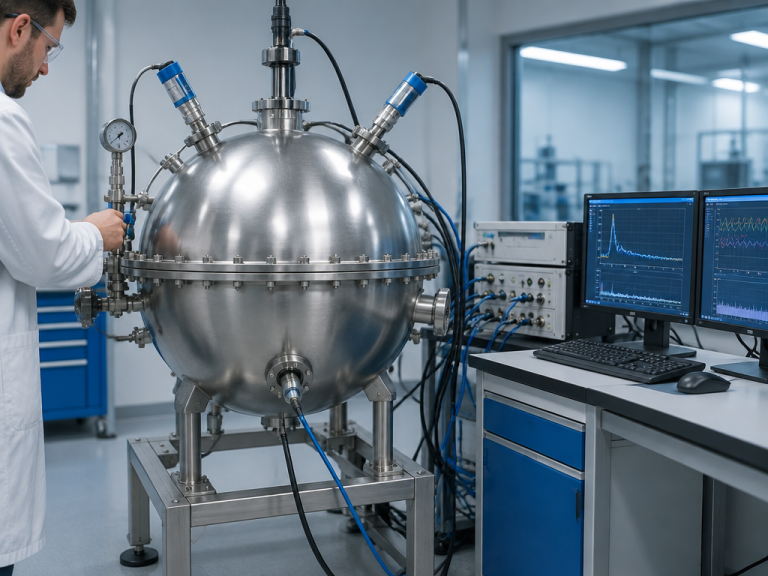
In a Go/No-Go test (ASTM E1226), dust is dispersed in a test chamber and exposed to a 5 kJ igniter.
1
Collect at least 100 grams of dust — 1 to 2 lb if further testing may follow — from inside your dust collector, its hopper, or high beams and ledges. How to collect a sample →
2
Ship the sealed, labelled sample to Craig Equipment in Louisville with a completed Sample Submission Form and the material’s Safety Data Sheet (SDS).
3
Craig Equipment has your sample tested in a qualified lab to ASTM E1226.
4
Craig Equipment returns the results to you and explains what they mean for your facility and your Dust Hazard Analysis.
Further testing shows how severe an explosion could be and how easily one could start: explosion severity (KSt and Pmax), minimum explosible concentration (MEC) and minimum ignition energy (MIE). At this stage Craig Equipment visits your facility, collects samples from the process and completes the full Dust Hazard Analysis.
A No-Go result does not mean there is no hazard. Dust layers can still smoulder or burn. Follow-up tests measure the minimum ignition temperature of a dust cloud (MIT), the hot-surface ignition temperature of a dust layer (LIT) and the burn rate, so your DHA can account for fire risk.
The lab may sieve your sample below 420 µm (40 mesh) — the size OSHA and NFPA use to define a dust — so that it disperses into a cloud.
ASTM and some NFPA guidance recommend testing at particle sizes below 75 µm and moisture below 5% by weight. Testing that does not follow the ASTM/EN recommendations can produce explosion severity and sensitivity data that is not conservative enough for designing explosion protection.
The Sample Submission Form lets you request sieving, milling (not recommended for metals) or drying before testing.

Want to know whether your dust is explosible? Send Craig Equipment a sample. Craig Equipment has it tested in a qualified lab and returns the results to you.
Serving Kentucky and Southern Indiana.
Contact Us - We Can Help