
Craig Equipment guides Kentucky and Southern Indiana manufacturers through the six steps of a Dust Hazard Analysis (DHA), from dust testing to action plan. Under NFPA 660, the steps are: confirm the dust is combustible, gather process documentation, form a DHA team, identify hazards and safeguards, rank them by likelihood and severity, and document an action plan that is reviewed at least every five years. Craig Equipment collects samples on site, has them tested in a qualified lab, writes the DHA report and quotes the equipment it recommends.
Every Dust Hazard Analysis begins with one question: is your dust combustible? The simplest way to find out is a Go/No-Go test. You collect a dust sample and send it to Craig Equipment. Craig Equipment has your sample tested in a qualified lab and returns the results to you.
If the result is “Go,” your dust is explosible and your facility needs a complete DHA — the six steps below. Even a “No-Go” result can call for further fire-hazard testing, so the conversation doesn’t end there.
About the Go/No-Go test →
How to collect and ship a dust sample →
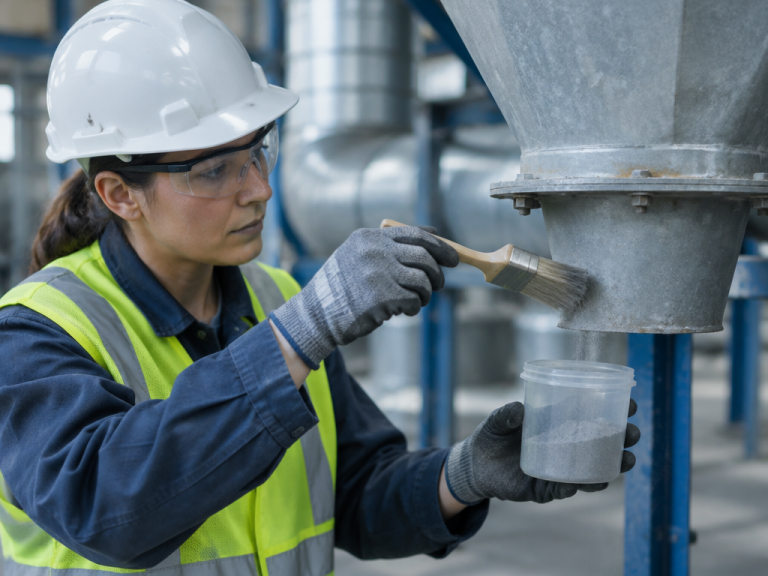
A dust sample from the collector hopper is the starting point for Go/No-Go screening.
A DHA can feel daunting the first time. Broken into steps, it becomes a structured review your team can plan, staff and complete.
STEP 1
Gather the drawings and documents that define your processes, equipment, operating parameters and known hazards:
In older plants these documents are often out of date, so walk the process to verify them and create new drawings where none exist. Remember that material properties can change during processing: an inert raw material can become combustible once it is ground, dried or conveyed, so combustible dust testing may be needed at several points. Related standards such as NFPA 68 (deflagration venting) and NFPA 69 (explosion prevention systems) may also apply.
STEP 2
NFPA recommends a team approach led by a qualified person. A strong team draws on plant engineering, management, safety, operations and maintenance, with union representation where applicable.
An outside specialist brings experience from other plants and industries and often spots hazards — and solutions — that an internal team misses. Craig Equipment can fill that role, from collecting samples to writing the final report.
STEP 3
This is the core of the DHA. Evaluate every point where dust is handled for the five elements of a dust explosion:
At each point, ask: Is there enough dust to create a combustible atmosphere? Could it be dispersed into a cloud? Is there an ignition or heat source hot enough to ignite it? Then document the protection already in place. Compliant measures need no further action; gaps go on the list.
STEP 4
Compare how likely each hazard is with how severe the consequences could be. Some hazards need immediate action; others can be scheduled. The ranked list becomes your action plan, with an owner and a target date for every item.
STEP 5
NFPA 660 requires the DHA to be documented: what was found, what has been corrected, when the remaining hazards will be addressed, and progress against the plan. These records demonstrate compliance to the Authority Having Jurisdiction and to OSHA inspectors, and they become the reference point for future equipment and process changes.
STEP 6
A DHA is a living document. Update it whenever your facility or process changes, and review it at least every five years even if nothing seems to have changed. Common triggers:
Craig Equipment does not run laboratory tests itself. It manages the process around them, from the first sample to the equipment that controls the hazard.
You collect a dust sample and send it to Craig Equipment with a completed Sample Submission Form. Craig Equipment has your sample tested in a qualified lab and returns the results to you.
If your dust is combustible, Craig Equipment visits your facility, collects samples from the process, has them tested in a qualified lab for explosion severity and ignition sensitivity, and writes the final DHA report, with a mitigation plan where one is needed.
Craig Equipment quotes the equipment, installation and plant changes the DHA calls for, including Donaldson Torit dust collectors, BOSS explosion venting, isolation and spark detection, and US Duct ductwork.

Ready to start your Dust Hazard Analysis, or not sure where you stand? Craig Equipment will walk you through it, one step at a time.
Serving Kentucky and Southern Indiana.
Contact Us - We Can Help